
by Adrian Worton
Last time out we looked at how we can modify our General Election simulator using odds from the previous election. We won't go into detail about what this involves, except to say that it increases the chance of the favourite winning each seat.
Making these changes to our model, and updating the odds, means we can give our latest predictions for the election.
Last time out we looked at how we can modify our General Election simulator using odds from the previous election. We won't go into detail about what this involves, except to say that it increases the chance of the favourite winning each seat.
Making these changes to our model, and updating the odds, means we can give our latest predictions for the election.
Individual constituencies
As with our March update, you can view the latest probabilities for your own local constituency! Simply use the drop-down list on the widget below:
As with our March update, you can view the latest probabilities for your own local constituency! Simply use the drop-down list on the widget below:
You should notice that the difference between the favourites and the rest is extended compared to the previous update.
We can now go through our predictions for each party individually.
Independents
Below are the chances of success for all candidates which are only contesting one seat within our model:
We can now go through our predictions for each party individually.
Independents
Below are the chances of success for all candidates which are only contesting one seat within our model:
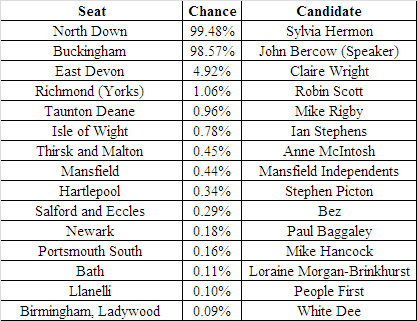
This is the best example of how our alteration of our model has affected candidates' chances, as we see the two favourites stretch their leads to almost-untouchable status, whereas the others all become incredibly long shots.
For the other parties within our model, we will get our number of seats from our usual method of running 1000 simulations.
Minor British parties
For the other parties within our model, we will get our number of seats from our usual method of running 1000 simulations.
Minor British parties
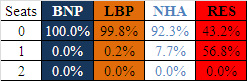
Next are those parties (outside of Northern Ireland) who are only contesting a handful of seats: the BNP, the Liberal Party, National Health Action Party and Respect. Their results can be seen on the right.
None of these won more than 1 seat, and indeed only Respect look capable of really finishing May with representation in government.
Northern Irish parties
There are six exclusively Northern Irish parties within our model. Below you can see their seat probabilities:
None of these won more than 1 seat, and indeed only Respect look capable of really finishing May with representation in government.
Northern Irish parties
There are six exclusively Northern Irish parties within our model. Below you can see their seat probabilities:
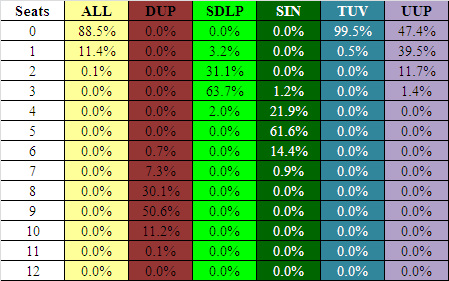
All simulations finished with the Democratic Unionist Party (DUP) having the most seats.
Now, onto the seven "debate" parties:
Green Party
Now, onto the seven "debate" parties:
Green Party
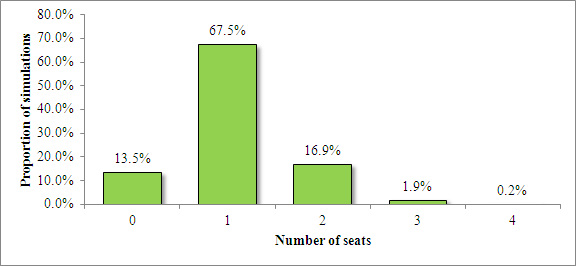
Whilst the graph indicates a huge decrease from March, this is really the effect of our altered model; the Greens are only favourites in one constituency, the others they were fighting to gain were all outside bets, all of which have rapidly diminished.
Plaid Cymru
Plaid Cymru
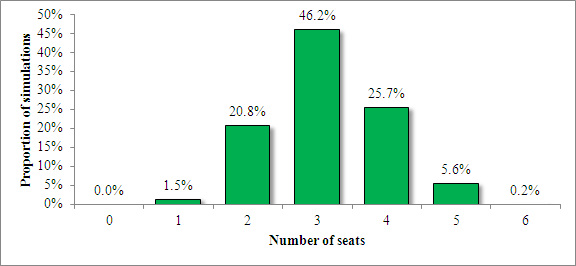
The change in the model narrows down the range we'd expect to see Plaid's seats be within, with their tally of three only realistically expected to change by one, in either direction, if at all.
United Kingdom Independence Party
United Kingdom Independence Party
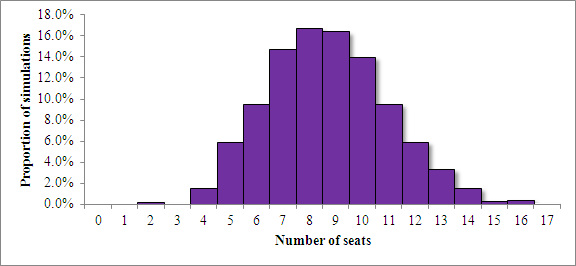
Whilst it would be delightful if Nigel Farage's comments during the leaders' debate had caused the colossal decrease in UKIP's performance in our model, really it is just the effect of our modelling shift. UKIP's over-performance was the main signifier that our original model overestimated the chances of non-favourites, and their peak is now roughly 20 seats below their peak when we looked at their chances in December. But an increase on their current tally of 2 seats seems inevitable.
Liberal Democrats
Liberal Democrats
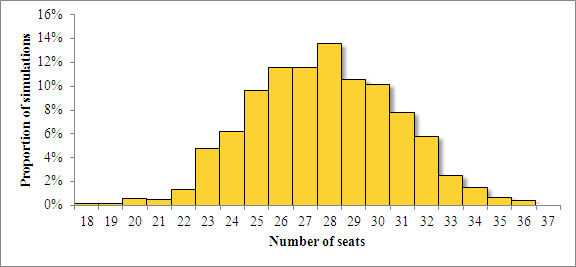
Continuing their perpetual fall from grace, the Lib Dems are now in a position where losing over half of their 57 seats is a real possibility. The news in the last week that Nick Clegg is polling in second-place in his own constituency of Sheffield Hallam will not be helping party morale.
Scottish National Party
Scottish National Party
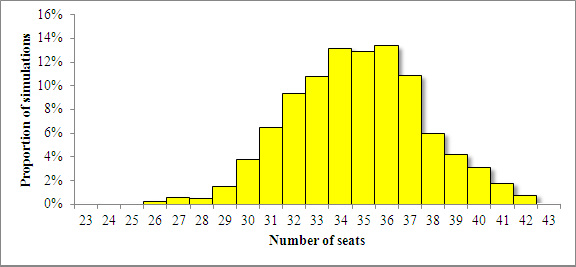
Our results back up the polls which suggests that Nicola Sturgeon's party is set to defy the best efforts of the Daily Telegraph and take the vast majority of seats in Scotland and move into the position of the third-biggest party in the country. Whilst all the previous parties we have looked at have seen a decrease from our old modelling, the SNP see a large increase, and this is because they are the favourites in most seats they are standing in.
Conservative Party
Conservative Party
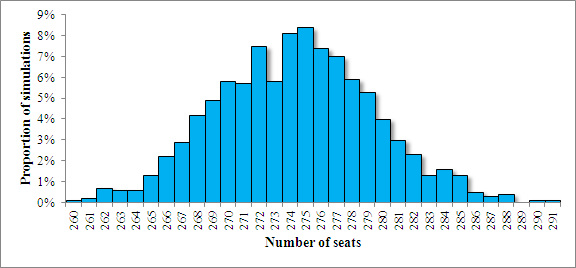
Another party to be favourites in most seats they're contesting, the Conservatives see a rise in performance. They are still set to make a loss on their current 303 seats, but will they cling onto enough to secure a lead over Labour?
Labour Party
Labour Party
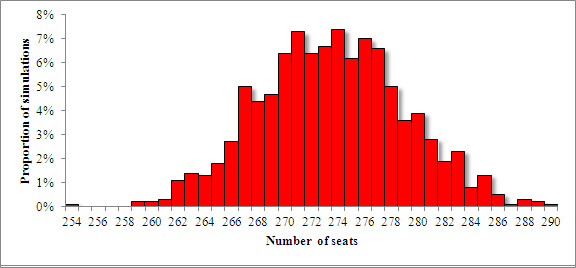
On first appearance, Labour might have just fallen behind their rivals, with their highest and lower values both slightly below that of the Conservatives. However, the number of seats each party will earn is not independent, therefore we need to look at the two sets of results plotted against each other.
Conservatives vs. Labour
Conservatives vs. Labour
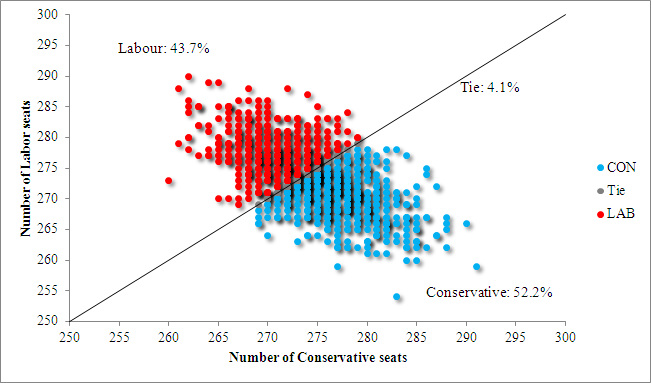
In December we found that Labour won 93.7% of the time. This value has shrunk rapidly, and now the Conservatives have taken the lead in the TGIAF model for the first time. But given the stance of the SNP, currently the most influential of potential coalition partners, on their support (or lack thereof) of a Conservative government, even a lead in seats is not necessarily all that is required to form a government in May.
Conclusion
It is unsurprising to see which parties have improved and declined due to our alteration in modelling approach, but the effect has been quite extreme. It has also largely narrowed the ranges of seats we'd expect the parties to return, meaning come the election we have more confident predictions.
Our General Election Simulator page has been updated with this model.
Conclusion
It is unsurprising to see which parties have improved and declined due to our alteration in modelling approach, but the effect has been quite extreme. It has also largely narrowed the ranges of seats we'd expect the parties to return, meaning come the election we have more confident predictions.
Our General Election Simulator page has been updated with this model.
General Election articles
Previous: Learning from the Past
Next: How to Beat the Bookies at Their Own Game
Previous: Learning from the Past
Next: How to Beat the Bookies at Their Own Game
 RSS Feed