by Dr Adrian Worton
Yesterday, we unveiled TGIAF's 2019 General Election model. We only have roughly half the seats available at the moment, we could only compare those seats to see where the parties stand, and use those to create a tentative prediction for the country overall.
However, all the missing seats are in England. So our next few articles will look at Northern Ireland, Wales and Scotland to see how those battles are shaping up.
Yesterday, we unveiled TGIAF's 2019 General Election model. We only have roughly half the seats available at the moment, we could only compare those seats to see where the parties stand, and use those to create a tentative prediction for the country overall.
However, all the missing seats are in England. So our next few articles will look at Northern Ireland, Wales and Scotland to see how those battles are shaping up.
Today we look at Northern Ireland. The smallest of the UK nations, it only has 18 constituencies. We will go through these in order of interest, starting with those that appear foregone conclusions:
Almost-certain favourite
First of all, the safe seats. These are ones, according to our model, where the incumbent has over a 99% chance of keeping their seat:
Almost-certain favourite
First of all, the safe seats. These are ones, according to our model, where the incumbent has over a 99% chance of keeping their seat:
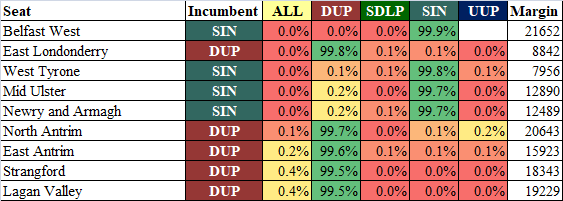
Each seat has a five-digit majority with the exception of two. One of these elections - West Tyrone - was a by-election, where turnout is lower, whilst East Londonderry is just below at 8,842. It's hard to see these seats changing hands at the election.
This gives the DUP (Democratic Unionist Party) a base of 5 seats and Sinn Féin 4.
Heavy favourite
Next up are the seats where the favourite has a 80-99% chance of retaining their seat. We've seen a fair few seats with such probabilities switch hands in the previous General Elections:
This gives the DUP (Democratic Unionist Party) a base of 5 seats and Sinn Féin 4.
Heavy favourite
Next up are the seats where the favourite has a 80-99% chance of retaining their seat. We've seen a fair few seats with such probabilities switch hands in the previous General Elections:
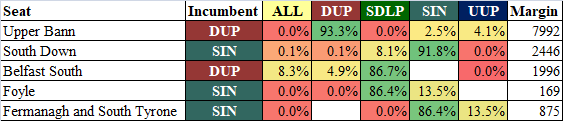
Upper Bann and South Down are expected to be holds, albeit less comfortably than the seats above.
Interestingly, in the next two cases it is not the incumbent that is the heavy favourite, as the SDLP (Social Democratic & Labour Party) are expected to take a seat from each of the DUP and Sinn Féin.
In Belfast South the SDLP finished 4.5% behind the DUP. However, this time round Sinn Féin (who took 16.3% in 2017) have announced that they will not field a candidate to give the SDLP a clear run. How much of their vote switches to the SDLP remains to be seen, but that is the factor which sees the SDLP become strong favourites for this seat.
In Foyle the SDLP were very narrowly beaten by Sinn Féin. With polling suggesting that support for the main two parties is waning (potentially as a result of the ongoing Northern Irish Assembly suspension), it is expected that the SDLP will regain the seat they lost two years ago.
Fermanagh & South Tyrone is another seat where Sinn Féin have a narrow majority. This time, they are expected to see off the UUP (Ulster Unionist Party), possibly as the latter had a poor showing in the 2019 European Elections.
Marginals
Now to the close seats, the ones where the favourite has less than 80% chance of winning:
Interestingly, in the next two cases it is not the incumbent that is the heavy favourite, as the SDLP (Social Democratic & Labour Party) are expected to take a seat from each of the DUP and Sinn Féin.
In Belfast South the SDLP finished 4.5% behind the DUP. However, this time round Sinn Féin (who took 16.3% in 2017) have announced that they will not field a candidate to give the SDLP a clear run. How much of their vote switches to the SDLP remains to be seen, but that is the factor which sees the SDLP become strong favourites for this seat.
In Foyle the SDLP were very narrowly beaten by Sinn Féin. With polling suggesting that support for the main two parties is waning (potentially as a result of the ongoing Northern Irish Assembly suspension), it is expected that the SDLP will regain the seat they lost two years ago.
Fermanagh & South Tyrone is another seat where Sinn Féin have a narrow majority. This time, they are expected to see off the UUP (Ulster Unionist Party), possibly as the latter had a poor showing in the 2019 European Elections.
Marginals
Now to the close seats, the ones where the favourite has less than 80% chance of winning:

All four see the DUP as favourite, but not by much.
North Down is a constituency that may be known to fellow constituency nerds, as it is the only one to return an Independent MP in each of the past three elections (Lady Sylvia Hermon). However, she is standing down this time, and this is expected to open the door to the DUP, who had narrowed her majority last time around. However, with the DUP's poll share much lower than their 2017 result, this might open the door to Alliance.
The Liberal Democrat-aligned Alliance have an even better chance in Belfast East, as both Sinn Féin and the SDLP stand aside. However, this isn't as useful as it appears, as the two parties took a combined 1,161 votes in the last election, well short of the DUP's majority of 8,474.
In South Antrim the UUP are expected to challenge, as the DUP's falling poll share may see them slip up. Alliance also remain in the hunt there, although they were over 13,000 votes behind the DUP last time round.
The most exciting contest is in Belfast North, as the odds have the DUP and Sinn Féin almost even. The SDLP are standing aside, and the number of votes they received is almost exactly equal to the DUP's majority (2,058 vs 2,081). The UUP are standing aside to aid the DUP, but they didn't stand last time. This will simply be a battle to see which of the main two parties maintains their 2017 votes best.
Brexit Implications
It is unfair to reduce the Northern Irish parties to their stances on Brexit, but this is likely to be the area where Northern Irish parties have the most influence.
It is well-known that the DUP are pro-Brexit, despite their issues with various government deals. The UUP campaigned for Remain in 2016, but now are pro-Brexit. Sinn Féin don't take up their seats in Westminster, effectively meaning they count as neutral (despite the party being pro-Remain). The SDLP and Alliance are pro-Remain.
With the UUP only likely to take a seat from DUP, therefore they are unlikely to change the Brexit balance of parliament. The DUP themselves are realistically only in the hunt for one extra seat (North Down).
With the SDLP and potentially Alliance gaining seats, and the chance of Sinn Féin taking Belfast North, it is likely that Northern Ireland's votes overall would be more pro-Remain than they were in the last parliament.
Conclusion
With all the recent talk of tactical voting in Britain, with parties struggling to come to arrangements to stand aside for each other, Northern Irish parties have managed this much more effectively (if only they could be so good at arranging an Assembly, yadda yadda...).
As in Britain, the last election saw voters move towards a duopoly. As in Britain, voters seem disillusioned by those two, and have drifted away. Tactical voting means that individual seats will likely all be two-way battles (or one-horse races), but there is a possibility that the 18 seats could return as many as 5 different parties, which would be the most satisfyingresult from an aesthetic perspective.
Next time we'll break down the seats in Wales.
North Down is a constituency that may be known to fellow constituency nerds, as it is the only one to return an Independent MP in each of the past three elections (Lady Sylvia Hermon). However, she is standing down this time, and this is expected to open the door to the DUP, who had narrowed her majority last time around. However, with the DUP's poll share much lower than their 2017 result, this might open the door to Alliance.
The Liberal Democrat-aligned Alliance have an even better chance in Belfast East, as both Sinn Féin and the SDLP stand aside. However, this isn't as useful as it appears, as the two parties took a combined 1,161 votes in the last election, well short of the DUP's majority of 8,474.
In South Antrim the UUP are expected to challenge, as the DUP's falling poll share may see them slip up. Alliance also remain in the hunt there, although they were over 13,000 votes behind the DUP last time round.
The most exciting contest is in Belfast North, as the odds have the DUP and Sinn Féin almost even. The SDLP are standing aside, and the number of votes they received is almost exactly equal to the DUP's majority (2,058 vs 2,081). The UUP are standing aside to aid the DUP, but they didn't stand last time. This will simply be a battle to see which of the main two parties maintains their 2017 votes best.
Brexit Implications
It is unfair to reduce the Northern Irish parties to their stances on Brexit, but this is likely to be the area where Northern Irish parties have the most influence.
It is well-known that the DUP are pro-Brexit, despite their issues with various government deals. The UUP campaigned for Remain in 2016, but now are pro-Brexit. Sinn Féin don't take up their seats in Westminster, effectively meaning they count as neutral (despite the party being pro-Remain). The SDLP and Alliance are pro-Remain.
With the UUP only likely to take a seat from DUP, therefore they are unlikely to change the Brexit balance of parliament. The DUP themselves are realistically only in the hunt for one extra seat (North Down).
With the SDLP and potentially Alliance gaining seats, and the chance of Sinn Féin taking Belfast North, it is likely that Northern Ireland's votes overall would be more pro-Remain than they were in the last parliament.
Conclusion
With all the recent talk of tactical voting in Britain, with parties struggling to come to arrangements to stand aside for each other, Northern Irish parties have managed this much more effectively (if only they could be so good at arranging an Assembly, yadda yadda...).
As in Britain, the last election saw voters move towards a duopoly. As in Britain, voters seem disillusioned by those two, and have drifted away. Tactical voting means that individual seats will likely all be two-way battles (or one-horse races), but there is a possibility that the 18 seats could return as many as 5 different parties, which would be the most satisfyingresult from an aesthetic perspective.
Next time we'll break down the seats in Wales.
 RSS Feed