by Dr Adrian Worton
This week we are looking at how a Progressive Alliance can prevent a Conservative majority by coordinating together to win enough seats for a majority. Last time we looked at the arithmetic of such an undertaking, and defined which seats should be considered already safe. We found that of 284 seats that aren't safe, the Progressive Alliance would need to win 238 in order to outnumber the Conservatives and related parties.
We are now going to look at each region of the country to see where the key battles are. In this article, we are going to look at all the regions in the south of England.
This week we are looking at how a Progressive Alliance can prevent a Conservative majority by coordinating together to win enough seats for a majority. Last time we looked at the arithmetic of such an undertaking, and defined which seats should be considered already safe. We found that of 284 seats that aren't safe, the Progressive Alliance would need to win 238 in order to outnumber the Conservatives and related parties.
We are now going to look at each region of the country to see where the key battles are. In this article, we are going to look at all the regions in the south of England.
In England, the parties making up the Progressive Alliance are Labour, the Liberal Democrats and the Greens. As UKIP are likely to side with the Conservatives on many key issues, we will include them on the Conservative side.
The West Country (Cornwall, Devon, Dorset, Somerset, Wiltshire)
Total seats: 38
Safe seats: CON 25
With only 13 seats realistically up for grabs, this is clearly a very strong area for the Conservatives. The upside of this is that resources for progressive parties do not need to be split widely between the key constituencies. Below is a graph of each key seat and its probabilities:
The West Country (Cornwall, Devon, Dorset, Somerset, Wiltshire)
Total seats: 38
Safe seats: CON 25
With only 13 seats realistically up for grabs, this is clearly a very strong area for the Conservatives. The upside of this is that resources for progressive parties do not need to be split widely between the key constituencies. Below is a graph of each key seat and its probabilities:
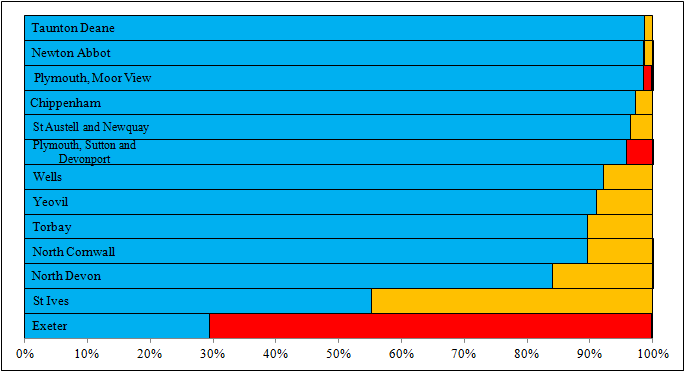
Currently, all seats other than Exeter are Conservative-held, and this may well continue.
We can see that in each seat, there is only one realistic opposition. Generally, the Lib Dems are the best opposition in less populated areas, whilst Labour are the best opposition in cities (this is a trend which will continue across regions). Therefore, it is clear that in this area that Labour should focus on Exeter and Plymouth, whilst the Lib Dems focus on the remaining regions.
South Coast (Hampshire, Isle of Wight, West Sussex, East Sussex)
Total seats: 35
Safe seats: CON 26
We can see that in each seat, there is only one realistic opposition. Generally, the Lib Dems are the best opposition in less populated areas, whilst Labour are the best opposition in cities (this is a trend which will continue across regions). Therefore, it is clear that in this area that Labour should focus on Exeter and Plymouth, whilst the Lib Dems focus on the remaining regions.
South Coast (Hampshire, Isle of Wight, West Sussex, East Sussex)
Total seats: 35
Safe seats: CON 26
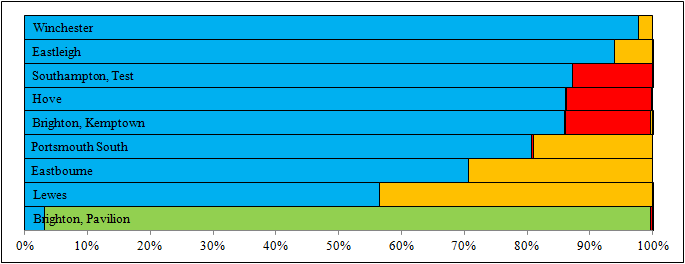
As with the West Country, this area is very Conservative-dominated. The good news for the Greens is that they appear set to successfully defend Brighton Pavilion, and with no other realistic seat chances here, can devote a lot of resources on ensuring it. Again, most seats here see the Lib Dems best-placed to challenge the Conservatives, and they will have to use their resources well to challenge on multiple fronts. Labour, meanwhile, need to ensure they keep their Hove and Southampton Test seats, whilst also challenging for Brighton Kemptown.
West England (Avon, Gloucestershire, Shropshire, Herefordshire, Worcestershire)
Total seats: 30
Safe seats: CON 23
West England (Avon, Gloucestershire, Shropshire, Herefordshire, Worcestershire)
Total seats: 30
Safe seats: CON 23
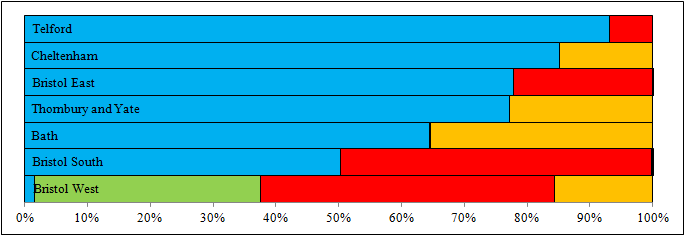
This area is interesting. Labour currently hold the three Bristol seats, but have a small chance of taking Telford. The Liberal Democrats should focus on Bath, Thornbury & Yate and Cheltenham. However, a real battle has developed in Bristol West, where the progressive parties face a three-way marginal. With no real Conservative presence, it will be tempting for each party to put a lot of effort into winning this seat, however this would likely harm their chances in the other seats, which are significantly more important.
Home Counties West (Berkshire, Buckinghamshire, Oxfordshire, Surrey)
Total seats: 32
Safe seats: CON 27; IND 1
Home Counties West (Berkshire, Buckinghamshire, Oxfordshire, Surrey)
Total seats: 32
Safe seats: CON 27; IND 1
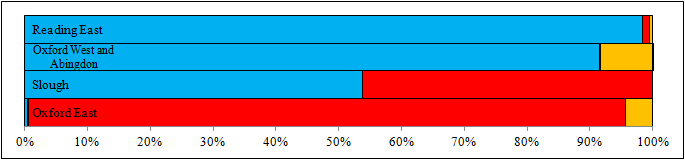
Despite covering four counties, there are only 4 seats that a Progressive Alliance could realistically target. The most difficult of these is Reading East, where Labour and the Lib Dems really need to work together in order to have any chance of unseating the Conservatives. It is more simple in Oxford West & Abingdon and Slough, where the Lib Dems and Labour should concentrate on each seat respectively. In Oxford East a Conservative victory is very unlikely, and whilst the Lib Dems have a small chance here, they would be better off leaving this seat to Labour, perhaps in return for support in another seat.
Home Counties East (Essex, Kent, Hertfordshire)
Total seats: 46
Safe seats: CON 41
Home Counties East (Essex, Kent, Hertfordshire)
Total seats: 46
Safe seats: CON 41
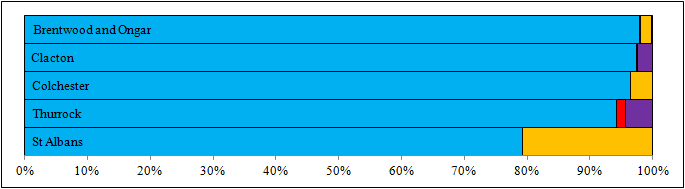
This is the area where UKIP have had their best successes, and it also appears to be the toughest area across the whole country for a Progressive Alliance to have success. Clacton, which appears to only be between the Conservatives and UKIP, has to essentially be written off by progressive parties. Labour's only hope, thin though it may be, is in Thurrock. As such, they should leave the Lib Dems a clear run at Brentwood & Ongar, Colchester and St Albans, as they will need it.
South London
Total seats: 37
Safe seats: CON 10; LAB 9
South London
Total seats: 37
Safe seats: CON 10; LAB 9
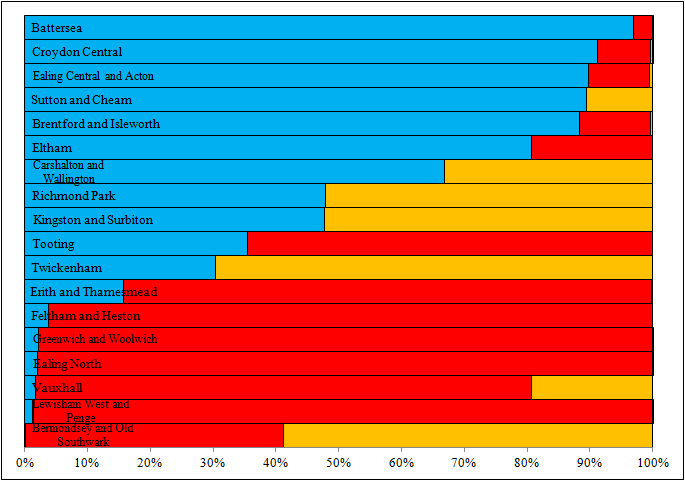
With just 19 seats in this area safe, this is a huge region for progressive parties to win. It also represents the best chances of stealing Conservative-held seats, in particularly in Twickenham, where Vince Cable will be trying to regain the seat he lost two years ago. However, on a similar note the Lib Dems face a battle to keep Richmond Park, where Zac Goldsmith will also be trying to return to Parliament. The graph above clearly gives an idea of which progressive party should work on which seat, with the only unclear ones being Vauxhall and Bermondsey & Old Southwark. These are good opportunities for the Lib Dems to take Labour seats, but if both parties are serious about working together to prevent a hard Brexit, they might decide to split the two seats.
North London
Total seats: 36
Safe seats: LAB 10; CON 9
North London
Total seats: 36
Safe seats: LAB 10; CON 9
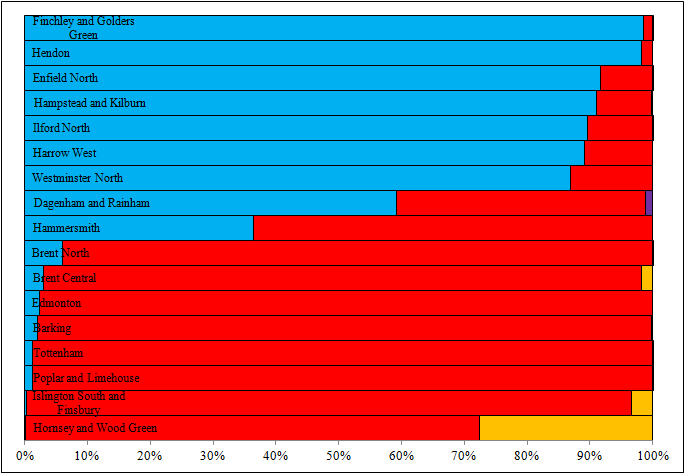
Just as with South London, this is a real open region in terms of which party could dominate. All seats in the graph are Labour-held, except Finchley & Golders Green and Hendon. This means Labour face a real struggle to hold a lot of seats here, and may require support from the Lib Dems, and certainly the Greens. With a possible UKIP challenge in Dagenham & Rainham, Labour will hope this takes votes away from the Conservatives.
Conclusion
The south of England represents possibly the biggest challenge for progressive parties, with the Conservatives favourites in a huge proportion of seats. With plenty of ex-Lib Dem seats possibly there to be regained, collaboration between both them and Labour appears key to combat the Conservatives.
If anywhere could be described as the Conservative heartlands, it is certainly the south of England. Next time, we will be looking at the rest of England, where Labour hold far more seats, and where they will be facing many battles to keep their seats.
On a personal note, I should add that the areas above represent approximately half of England in terms of constituencies (254 of 533), but in no way am I suggesting that the north of England starts above here - this divide is cultural and clearly starts at the imaginary line between Liverpool and Sheffield.
Conclusion
The south of England represents possibly the biggest challenge for progressive parties, with the Conservatives favourites in a huge proportion of seats. With plenty of ex-Lib Dem seats possibly there to be regained, collaboration between both them and Labour appears key to combat the Conservatives.
If anywhere could be described as the Conservative heartlands, it is certainly the south of England. Next time, we will be looking at the rest of England, where Labour hold far more seats, and where they will be facing many battles to keep their seats.
On a personal note, I should add that the areas above represent approximately half of England in terms of constituencies (254 of 533), but in no way am I suggesting that the north of England starts above here - this divide is cultural and clearly starts at the imaginary line between Liverpool and Sheffield.
 RSS Feed